Understanding My Rejection Sensitivity - Professional Use

$40.00

A Schema Therapy–Informed Worksheet for Mode Awareness & Healthy Adult Responses

[Please note: this is the professional-use version of this resource and may be used with clients as part of therapeutic or educational work. under licence]

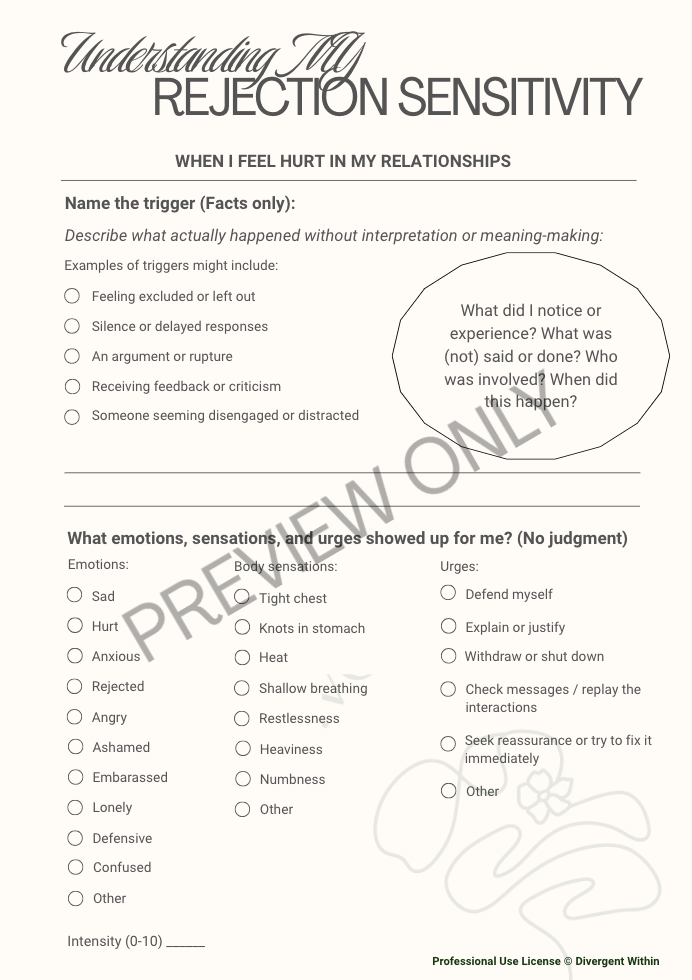
Rejection sensitivity can activate intense emotional responses to perceived criticism, exclusion, or disconnection, often long before we consciously realise what’s happening. This worksheet is designed to slow that process down.

Understanding My Rejection Sensitivity is a structured, reflective tool that helps individuals identify which parts of themselves (or schema modes) are activated, and develop clear, compassionate Healthy Adult responses.

Rather than focusing on “fixing” rejection sensitivity, this resource supports awareness, regulation, and choice.

What this worksheet helps with:

  • Understanding rejection sensitivity through a Schema Therapy framework

  • Identifying activated modes (e.g. Vulnerable Child, Angry Child, Anxious/Compliant Coping, Detached Protector)

  • Distinguishing between emotional activation and values-based responses

  • Reducing impulsive reassurance-seeking or withdrawal cycles

  • Strengthening internal regulation and Healthy Adult responses

Common triggers this resource can support:

  • Perceived exclusion or being left out

  • Delayed responses or ambiguous communication

  • Feedback or criticism

  • Conflict, rupture, or relational uncertainty

  • Situations where emotions feel “out of proportion” but very real

What’s included:

  • 1 professionally designed PDF worksheet (A4)

  • Clear psychoeducational prompts

  • Guided reflection and reframing questions

  • Healthy Adult Mode language and grounding statements

Who this is for:

  • Adults exploring rejection sensitivity, emotional reactivity, or attachment-based triggers

  • Neurodivergent individuals (including ADHD and autistic adults)

  • Clinicians supporting clients with RSD, schema activation, or interpersonal sensitivity

This resource is intended for reflection and psychoeducation, and is not a replacement for therapy or clinical care.

A Schema Therapy–Informed Worksheet for Mode Awareness & Healthy Adult Responses

[Please note: this is the professional-use version of this resource and may be used with clients as part of therapeutic or educational work. under licence]

Rejection sensitivity can activate intense emotional responses to perceived criticism, exclusion, or disconnection, often long before we consciously realise what’s happening. This worksheet is designed to slow that process down.

Understanding My Rejection Sensitivity is a structured, reflective tool that helps individuals identify which parts of themselves (or schema modes) are activated, and develop clear, compassionate Healthy Adult responses.

Rather than focusing on “fixing” rejection sensitivity, this resource supports awareness, regulation, and choice.

What this worksheet helps with:

  • Understanding rejection sensitivity through a Schema Therapy framework

  • Identifying activated modes (e.g. Vulnerable Child, Angry Child, Anxious/Compliant Coping, Detached Protector)

  • Distinguishing between emotional activation and values-based responses

  • Reducing impulsive reassurance-seeking or withdrawal cycles

  • Strengthening internal regulation and Healthy Adult responses

Common triggers this resource can support:

  • Perceived exclusion or being left out

  • Delayed responses or ambiguous communication

  • Feedback or criticism

  • Conflict, rupture, or relational uncertainty

  • Situations where emotions feel “out of proportion” but very real

What’s included:

  • 1 professionally designed PDF worksheet (A4)

  • Clear psychoeducational prompts

  • Guided reflection and reframing questions

  • Healthy Adult Mode language and grounding statements

Who this is for:

  • Adults exploring rejection sensitivity, emotional reactivity, or attachment-based triggers

  • Neurodivergent individuals (including ADHD and autistic adults)

  • Clinicians supporting clients with RSD, schema activation, or interpersonal sensitivity

This resource is intended for reflection and psychoeducation, and is not a replacement for therapy or clinical care.

Licensing and Terms

Note: This is a digital file. This resource and its contents are the intellectual property of Divergent Within. Each purchase is for single clinician use only. Group practices, organisations, or training providers must obtain a separate agreement. There are strictly no refunds.

Please see the terms of purchase here, for your reference: www.divergentwithin.com.au/terms-of-purchase